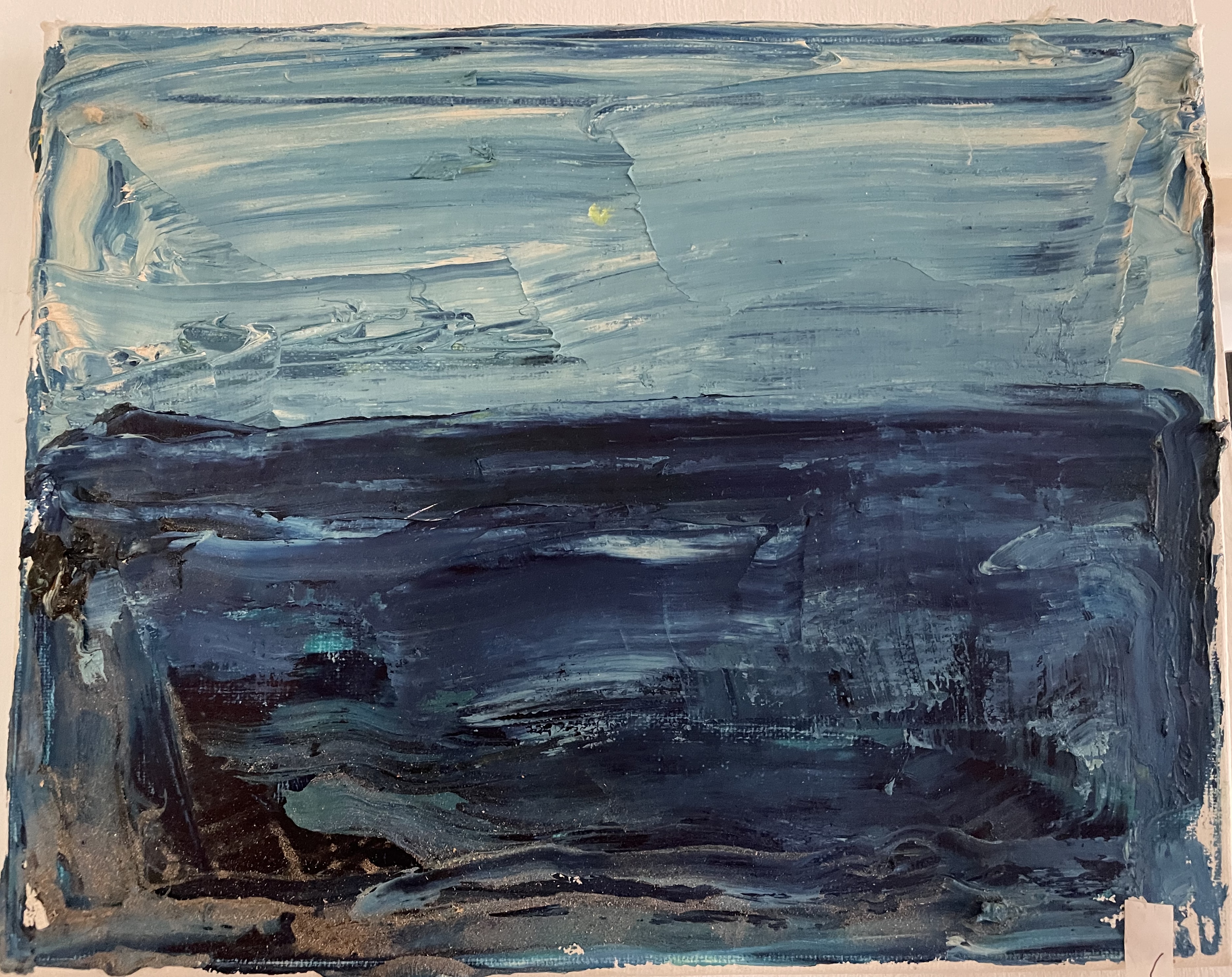
A smaller painting in landscape format with a marine-like two-part division: above a light, ice-blue zone; below a dark, almost blue-black zone with agitated strokes. In the light zone a single small yellow dot. A gritty, sandy passage is embedded in the paint mass. No signature visible.
Formally: the classic horizon division, but without gradients — light over dark, each zone with its own stroke direction. The yellow dot is the composition's only punctual element and carries disproportionate weight. Most striking: the embedded sand makes the shore a physical reality rather than a depiction — the painting contains its motif's material.
Interpretively: a nocturne over the sea, the yellow dot a fixed point of longing — the only thing the eye can hold on to. The presence of sand pulls toward the site-specific. Resonances with Emil Nolde and material painting after 1950 (Dubuffet, Tàpies).
The ambiguity: The yellow dot — deliberate or accidental? The entire mood of the painting depends on the answer.
The painting is horizontal, divided into a light blue-grey field at the top and a darker blue-black field below. The division at roughly mid-composition suggests a horizon, but thick, uneven and broken. In the light part: broad horizontal strokes, scraped marks and a small yellow-green dot near the upper centre. The dark part: blue, violet, grey and black movements plus a dark brownish area on the left.
The dark lower zone more dense and varied than the upper — heavier and closer. The horizon not a thin line but a massive band that almost closes the connection. The small yellow-green marking modest in colour but visible against the limited palette. The radically simplified sea motif connects to colour field painting, yet the rough surface pulls toward a more material expressive tradition.
Most ambiguous: The small yellow marking. Almost ignorable — but once seen, it organises the entire picture as a space with distance and scale.
Horizontal, divided into a light blue/white upper half and a dark blue-black lower half. A clear horizontal dividing line almost edge to edge as a definitive horizon. Upper: long, calm strokes with a wide brush. Small yellow-green dot centrally. Lower: short, turbulent strokes in blue, violet and black tones.
The horizon line is slightly skewed and breaks on the left — a comment on the landscape's instability? The small yellow dot interrupts the monochrome calm: moon, sun, distant ship — emphasising proportions and enormous infinity. Gustave Courbet's seascapes, Rothko, Allan Otte and older Danish colourist tradition.
Contradiction in materiality: We are presented with water and air (fluid, weightless elements), but they are conveyed through heavily material impasto — paint-lumps that shout of physical resistance against the nature of the elements depicted.
Lars Bruun's response not yet available.
Analyses produced by: Claude (Anthropic) · ChatGPT (OpenAI) · Gemini (Google)